

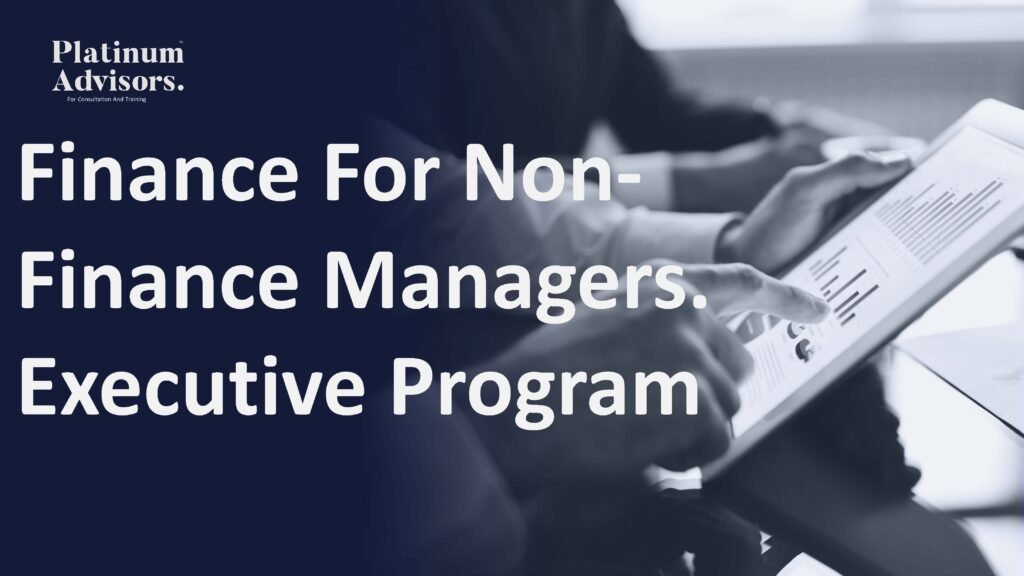

Description
Program Overview:
• Understand and apply the fundamentals of finance to support smarter business decisions.
• Improve your budget management skills, helping you control costs and allocate resources effectively.
• Increase your potential for profitability by using financial tools to optimize operations.
• Assess financial performance across departments, business units, or entire Organizations.
• Become familiar with key finance and accounting terminology, enabling smoother communication with finance professionals.
• Build confidence in interacting with financial reports and teams.
• Strengthen your readiness for senior management roles, where financial insight is crucial to strategic decision-making.
Program Outlines:
- Day 1
The key financial statements
- Understanding the accounting cycle
-The five main accounts in financial statements
-Income statement: a tool for performance measurement
o Accrual basis versus cash basis
- Balance sheet: a tool for financial position
- Statement of owners’ equity
- Statement of cash flows: cash is king
- Wrapping up: the cycle of financial statements
- External and internal auditors’ responsibilities
Day 2:
Analysis of financial statements
- Why are ratios useful?
- Horizontal and trend analysis
- Vertical analysis: common-size statements
- Common-size financial statements
· Building blocks analysis and reading through the numbers:
- Liquidity ratios: ability to settle short-term dues
- Solvency ratios: ability to settle long-term dues
- Activity ratios: the ability to manage assets efficiently
- Profitability ratios
- Limitations of financial ratio analysis
- Day 3:Working capital management-Definition of working capital and working capital management-Working capital management strategies for current assets- Balancing profitability and liquidity- Working capital management strategies for current liabilities- The trade-off between profitability and certainty Breakeven analysis and decision making- Defining fixed costs- Defining variable costs- Contribution margin formula- Computing the breakeven point
- Sensitivity analysis: changing assumptions
- Day 4:Operating budget process and techniques- What is the operating budget?- Steps to budget development- Master budget components- . Sales forecasting- Approaches to budgeting- Incremental budgeting- Zero-based budgeting- Budgetary control and correction
- Day 5:Capital budgeting: the investing decisions.- Examples of exercises involving capital budgeting- Time value of money: a prerequisite for investing decisions- The required rate of return for investments- Examples of cash outflows for capital projects- Examples of cash inflows for projects- Net present value calculation
- Who Should Attend? 1- C-Level Executives:CEOs: To understand the financial impact of strategic decisions.COOs: To align operational goals with financial outcomes.CMOs: To evaluate the ROI of marketing strategies.CHROs: To manage budgets for talent acquisition, retention, and HR initiatives. 2- Vice Presidents and Directors:Heads of departments such as Marketing, Operations, or IT who need to justify investments and evaluatefinancial risks.3- General Managers and Business Unit Heads:Responsible for P&L statements and aligning business unit goals with corporate financial objectives.4- Entrepreneurs and Board Members:
Entrepreneurs scaling their businesses or board members evaluating organizational performance.
- This Executive Program is designed to be delivered over: 5 Days of TrainingTotal Duration: 25 to 40 Hours, depending on session format and delivery mode.The program is available in two formats:•Standard Format: 5 days × 5 hours/day•Intensive Format: 3 days × 8 hours/day (Accelerated Delivery)This flexible structure allows participants to engage in deep, hands-on learning while accommodating theirexecutive schedules.



Add a review